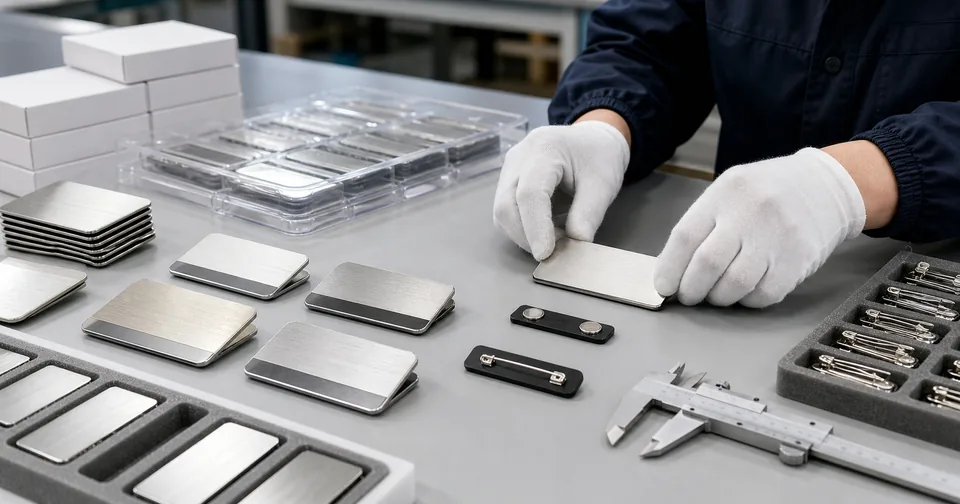
Searching for how to make a name tag can mean two very different things. You may need one temporary name label for a classroom, party or event. Or you may be planning a professional batch of name badges for employees, hotel staff, a retail team, a conference or a uniform program. The best making method depends on the use, the quantity and the finish you want the wearer to see every day.
A name tag looks simple, but a durable professional result requires several decisions. The name must remain readable at a practical distance. The base must be light enough for the garment. The surface must match the brand or uniform. The back must stay secure without damaging clothing. If you are ordering many different names, the data and proof process must also prevent spelling and layout errors.
The short answer: how do you make a name tag?
To make a professional name tag, start by defining the wearer, garment, reading distance, quantity and expected service life. Then choose a shape and size, select a base metal, decide how the name and logo will be applied, choose a finish and attachment, prepare production artwork, approve a proof or sample, and complete forming, marking, assembly, inspection and packing.
For a one-off temporary label, you can use paper, card, adhesive vinyl or a blank plastic holder. For a repeatable business identity item, custom metal name tags are usually more attractive and durable. A specialist manufacturer can engrave, print, enamel-fill or form the tag and can keep the approved layout available for future staff additions and reorders.
BadgeCraft Metalworks supplies custom metal name tags for offices, hotels, uniforms and promotional programs. Its related brushed metal name badges and engraved metal name tags pages show how the finish and marking method change the final appearance.
1. Define the use before making the name tag
The first decision is not the metal. It is the situation in which the name tag will be worn or installed. A receptionist, a restaurant server, a sales representative and a technician may all need a name tag, but their requirements are different.
Company uniforms and customer-facing staff
For offices, retail teams, clinics and hospitality staff, the name should be readable without making the badge feel oversized. A clean rectangle or softly rounded rectangle often gives enough room for a logo, an employee name and, when useful, a job title. A magnetic attachment is convenient for good garments because it does not pierce the fabric. For workwear, a pin or clip may be more practical.
Hotels, restaurants and service teams
Hospitality name tags are handled often and need a finish that remains presentable. Consider whether the badge will be exposed to moisture, cleaning products, abrasion or frequent removal. A brushed surface can reduce the appearance of small marks, while polished plating creates a more reflective premium look. Review the dedicated options for custom hotel name badges before selecting a layout.
Events, conferences and temporary programs
Events may need a large name area, a sponsor logo, a role or a session label. A reusable metal badge with interchangeable insert cards can be useful when names change often. A fixed engraved or printed name tag is better when the badge is intended to become part of a uniform or recognition program.
Equipment and identification applications
Not every name tag is worn by a person. If the item will identify a machine, room, asset or product rather than a team member, use a metal nameplate specification instead. Equipment nameplates and QR code metal tags need different choices for adhesive, holes, outdoor exposure, serial data and scanning contrast.
2. DIY name tags or custom metal production?
There is no single correct answer. The right route depends on quantity, deadline, durability and the impression the tag needs to create.
When a DIY name tag is enough
DIY works well for a single-day workshop, classroom activity, birthday party or temporary visitor pass. You can print the name on card, apply vinyl letters to a blank plastic badge or place a paper insert inside a reusable holder. This route is inexpensive and fast, but it may not resist water, friction or repeated cleaning. It also produces a different result each time unless you control the template and materials carefully.
For a simple DIY result, use a readable sans-serif typeface, keep the name away from the edge, and test the attachment on the actual garment. Avoid very thin paper if the tag will be handled often. If the name is difficult to read from two or three steps away, increasing the size and contrast is usually more helpful than adding decoration.
When to use a custom manufacturer
Custom manufacturing is a better fit when you need a consistent visual identity, a professional uniform, a durable surface, many employee names, repeat orders or a specific metal finish. The manufacturer can create one approved base design and then apply variable names from a list. It can also control the size, thickness, edge treatment, attachment position, packaging and inspection standard across the batch.
For bulk buyers, the most important benefit is repeatability. A good supplier should be able to keep the approved dimensions and artwork notes so a new order does not start from an uncertain screenshot. This is especially useful for companies that hire regularly, operate multiple locations or need replacements over time.
3. How a custom metal name tag is made
A custom metal name tag normally passes through the following production stages. The exact route changes with the material and the amount of relief, color and personalization required.
- Requirement review: confirm the use, quantity, name list, logo, dimensions, material, finish, attachment, packaging and delivery country.
- Artwork preparation: convert the logo and text into clean production artwork. Small details may need to be simplified so they remain legible at the finished size.
- Tooling or blank preparation: make a die, mold or cutting program when the shape or relief requires it. Flat tags may use a cut blank, while raised designs may need stamping or casting tooling.
- Forming: cut, stamp, die strike or cast the metal outline. Edges are checked for the correct shape and a comfortable finish.
- Surface preparation: polish, brush, bead-blast or otherwise prepare the surface for plating, printing, engraving or color.
- Marking and color: apply the name and logo through engraving, laser marking, printing, enamel filling or another approved method.
- Plating and finishing: apply gold, silver, antique, black nickel, copper or another finish when specified, then clean and inspect the visible surface.
- Attachment assembly: install a magnet, pin, clip, safety pin or other back. The position matters because it affects balance and how the tag sits on the garment.
- Inspection and packing: check names, spelling, dimensions, color, plating, attachment strength and quantity before packing the tags for shipment.
This sequence is why sending only a low-resolution screenshot is rarely enough for a reliable quote. A manufacturer needs to know what is meant to be raised, recessed, colored, polished or variable from one tag to the next.
4. Choose materials and marking methods
The base material changes the weight, edge, relief, cost and final feel of the name tag. The marking method changes the contrast and the way the name will age.
| Option | Best for | Planning notes |
|---|---|---|
| Stainless steel | Durable professional tags and long-term uniforms | Strong, clean and resistant to everyday wear; brushed or polished finishes are common. |
| Aluminum | Lightweight staff tags and identification pieces | Low weight and suitable for engraving, printing or anodized color depending on the design. |
| Brass | Classic decorative or die struck name badges | Works well with plated gold, silver and antique appearances; confirm the desired weight. |
| Zinc alloy | Raised logos, shaped emblems and dimensional designs | Useful for cast relief and custom outlines; the profile may be heavier than a flat tag. |
| Engraving or laser marking | Permanent names and restrained professional layouts | Excellent for readable text; contrast depends on the material and finish. |
| Digital or screen printing | Logos, multiple colors and fine flat artwork | Allows color detail without deep relief; ask about scratch resistance and protective coating. |
| Soft or hard enamel | Colorful brand badges and decorative name designs | Soft enamel has recessed color; hard enamel is filled and polished closer to a smooth surface. |
For a professional staff badge, stainless steel, aluminum and brass are common starting points. If the badge needs a raised company emblem or a shaped border, zinc alloy can provide more dimensional freedom. If the main requirement is a long, changeable employee name, a flat metal tag with engraving or printing may be more efficient than a fully cast relief.
Review the zinc alloy versus brass guide for more detail on cast and stamped construction. Although that article focuses on badges, the same material questions apply to name tags: how much relief is needed, how much weight is comfortable, and which finish supports the artwork?
5. Select size, thickness and attachment
Name tags should be large enough for fast recognition but small enough to sit naturally on a uniform. The final size is influenced by the longest name, logo width, job title, reading distance and the location of the attachment.
Size and layout
A horizontal rectangle is often the most efficient format for a first and last name. A wider tag gives room for a logo on the left and the name on the right. A square or custom outline can work when the brand mark is the main feature. If the tag must include a name, title and company logo, test the layout at actual size instead of judging it only on a large computer screen.
As a starting point, many staff name badges fall in a range of about 60 to 80 mm wide, but this is only a planning reference. Long names may need more width, while a compact uniform badge may need less. The size and thickness guide explains why finished dimensions should be confirmed before tooling.
Thickness and weight
Thickness affects rigidity, weight and the apparent quality of the piece. Very thin metal may feel light but can flex or show edge distortion. A thicker cast or layered badge can feel substantial but may pull on lightweight fabric. Ask the supplier for a recommended profile based on the material and attachment. For a magnetic tag, check that the magnet can support the final weight through the intended garment.
Back attachment
Magnetic backs are popular for shirts, jackets and hospitality uniforms because they do not make holes in the fabric. Pin backs are simple, familiar and often economical. Clips can suit workwear or users who need to remove the badge quickly. A safety pin may be suitable for some event or fabric applications, while adhesive backing is more relevant to flat identification plates than wearable staff tags.
Tell the manufacturer what fabric the tag will sit on. A strong magnet that works through a thick jacket may be unnecessarily heavy for a light shirt. Also confirm the number and position of posts or magnets, because an unbalanced layout can make a long tag rotate while worn.
6. Prepare artwork and variable name data
A logo file and a list of names are not the same as finished production artwork. The supplier needs to know which parts remain fixed and which parts change. It also needs to know the exact spelling, capitalization, punctuation and order of the variable information.
Vector PDF, AI or SVG files are usually the most useful starting formats for logos. PSD files can help when the design is raster-based, but the manufacturer may need to redraw small lettering or separate colors. Include brand colors as references, but remember that printed color, enamel and plated metal do not behave like a screen image. A physical sample is the best way to check the final appearance.
For multiple names, send a spreadsheet with one approved name per row. Include fields such as first name, last name, title, location and quantity only when they are needed. Use one consistent spelling source, remove duplicate rows, and mark accents or special characters clearly. Before production, review a proof that shows every name at its actual position and size.
If the name tag includes a QR code, serial number or employee ID, test the code on the final surface and at the intended scanning distance. Use custom QR code metal tags as a separate reference because contrast, quiet zone and surface glare matter more for machine scanning than for an ordinary name badge.
7. What to send a manufacturer for an accurate quote
A complete quote request reduces back-and-forth and makes supplier comparisons fairer. Include the following information in one message:
- Product type: staff name tag, hotel name badge, office badge, event tag or equipment plate.
- Quantity: total pieces and number of different names or designs.
- Finished dimensions: width, height, shape and any preferred thickness.
- Artwork: logo, text layout, colors and a clear production reference.
- Personalization: fixed artwork, variable employee names, titles, IDs or serial data.
- Material and finish: stainless steel, aluminum, brass, zinc alloy, brushed, polished, plated, printed or engraved.
- Attachment: magnet, pin, clip, safety pin or another back construction.
- Packaging: individual bags, backing cards, boxes, grouped packs or reorder labels.
- Delivery country and target date: these affect freight planning and production priority.
Ask the supplier to separate tooling, sampling, unit production, packaging and freight when possible. Also ask whether the minimum order applies to each name or to the complete design family. BadgeCraft Metalworks typically plans from about 100 pieces per design, but the practical minimum can change with the process, number of names, packaging and other specifications.
8. Understand cost and production timing
The cost of a name tag is not determined by the name itself. The main variables are material, size, thickness, shape, tooling, marking method, number of colors, plating, attachment, quantity, number of unique names, packaging and freight. A batch with one fixed logo and 500 identical pieces is simpler to plan than a batch with 100 different names, three finishes and individual presentation cards.
When comparing quotes, keep the specification the same. A lower price may exclude the sample, tooling, magnet, individual packing or shipping. Ask whether the quoted price includes artwork preparation and whether a revised proof is included when a spelling or layout change is requested. A clear quote is often more valuable than the lowest first number because it reduces surprises later.
For planning, BadgeCraft Metalworks uses about seven days for a sample and about 15 days for bulk production after the specification and sample are approved. This is a planning reference rather than a guarantee. Artwork revisions, special plating, variable data, custom packaging and freight add time, so include the event or uniform launch date in the first inquiry.
For a long-term program, ask how the supplier stores the approved artwork and variable-data layout. Future orders should use the same dimensions, finish and attachment unless you intentionally change them. This protects consistency when new employees join or when a hotel, office or retail group needs a replacement batch.
9. Inspect, wear and reorder the name tags
Before accepting a production batch, inspect a sample from the beginning, middle and end of the shipment when the quantity is large. Check the spelling, font size, alignment, logo color, plating, edge smoothness, magnet or pin position and package count. If the tags are for uniforms, test them on the actual fabric and confirm that they remain comfortable when worn for a full shift.
Care instructions depend on the finish. Avoid harsh abrasives on polished or plated surfaces. Wipe ordinary dust and fingerprints with a soft cloth. If the tag is exposed to water or cleaning chemicals, ask the supplier which surface and base metal are most suitable before ordering. For outdoor or industrial identification, a wearable name tag may be the wrong product; use a purpose-built industrial nameplate with an appropriate adhesive, hole or mounting method.
When reordering, reference the original approved proof rather than sending a new screenshot. State whether the new names use the same layout, dimensions, finish and attachment. This simple record makes it easier to keep the name tags consistent across departments and locations.
Why work with a specialist name tag manufacturer?
A specialist manufacturer can connect design decisions to actual production limits. It can tell you when a name is too small to engrave clearly, when a magnet is not strong enough for the selected metal profile, when a plated finish will change the perceived color, or when a logo needs simplification. That advice is useful before tooling, when changes are easier and less expensive.
It also gives you a clearer route for related products. A hotel group may need name badges for staff, keychains for guests and hotel name badges with one visual language. An office may need magnetic staff badges as well as custom office name badges. A company with technicians may need both wearable tags and engraved equipment plates. A supplier that understands the production family can keep the finishes and artwork standards aligned.
Review the office staff name badge case study and the hotel name badge case study for examples of how the use case changes the specification. You can also read the manufacturing process guide to understand what happens from artwork review through inspection and packing.
Frequently asked questions
How do you make a name tag?
Define the use, size, material, artwork, marking method and attachment first. Then prepare a production proof, approve a physical sample when needed, and manufacture, inspect and pack the name tags to the approved specification.
What is the best material for a name tag?
Stainless steel and aluminum are useful for durable professional name tags, while brass or zinc alloy can provide a more decorative or dimensional appearance. The best choice depends on use, weight, finish, artwork and budget.
Can I make a name tag from a logo or spreadsheet?
Yes. A logo can be converted into an engraved, printed, enamel or raised metal design. For multiple employee names, send a clear spreadsheet with the approved layout and variable text so the manufacturer can prepare a proof.
Should a name tag use a magnet or a pin?
Magnetic backs are convenient for uniforms and garments because they avoid piercing fabric. Pin backs are simple and economical, while clips can suit workwear or situations where a removable attachment is preferred.
What size should a custom name tag be?
Common planning ranges are about 60 to 80 mm wide for a staff name badge, but the correct size depends on name length, logo area, reading distance, garment and attachment. Request an artwork proof at the intended finished size.
How long does it take to make custom metal name tags?
A typical planning reference is about seven days for a sample and about 15 days for bulk production after approval. Artwork revisions, special finishes, variable names, packaging and freight can change the schedule.
Related pages: custom metal name tags, brushed metal name badges, engraved metal name tags, stainless steel name tags and request a quote.