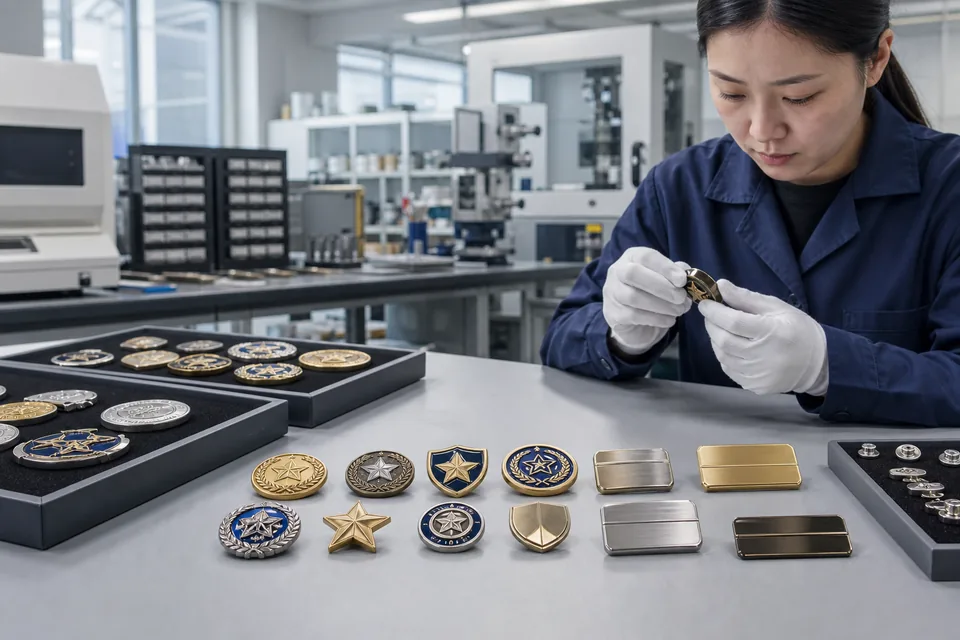
Searching for where can I get badges made usually means you already have a practical need: a company logo badge, a club or uniform badge, a lapel pin, a commemorative piece, an award or a metal identification plate. The difficult part is not finding a website that accepts an image. The difficult part is finding a supplier that can turn the image into a consistent product, explain the available options and deliver the order in the quantity and timeframe you need.
A good badge supplier should make the next decision easier. They should be able to discuss the difference between soft enamel, hard enamel, die struck relief, printed metal and cast zinc alloy; explain how size and thickness affect weight; recommend a suitable back attachment; provide a sample or proof; and state what is included in the quotation. These details matter whether you are ordering 100 pieces for a local event or a repeat batch for a distributor.
The short answer: where can you get badges made?
You can get badges made through four common supplier types:
- A specialist custom metal badge manufacturer: the best fit for bulk orders, technical specifications, repeat production and a wide range of finishes.
- An online merchandise or promotional products supplier: convenient for standard products, simple artwork and smaller purchasing teams, but the supplier may outsource production.
- A local awards, engraving or sign company: useful when you need local consultation, a short run or a fast pickup, although the range of metal forming and plating options may be narrower.
- A marketplace seller: a quick way to collect ideas and compare starting prices, but you need to confirm who actually manufactures the badges and who is responsible for inspection and reorders.
For a buyer who needs custom metal badges in a production quantity, a specialist manufacturer is usually the most direct starting point. BadgeCraft Metalworks produces custom metal badges, metal pins, coins, medals, name tags and equipment plates for B2B orders. The company typically starts at 100 pieces per design, plans about seven days for samples and about 15 days for bulk production after sample approval, with the final schedule depending on the specification.
That does not mean a factory is automatically the right choice for every order. Your location, quantity, deadline, required packaging and need for local support should guide the decision. The important point is to compare the complete production route, not only the first number shown in a search result.
Where to look for a reliable badge maker
Start by searching for the product name and the buying requirement together. Queries such as “custom metal badges manufacturer,” “custom lapel pins bulk,” “company logo badges,” “soft enamel pins wholesale” or “custom award medals manufacturer” reveal more useful suppliers than a broad search for “badges.” If you need technical plates rather than wearable badges, search for “equipment nameplates,” “metal data plates” or “engraved machinery plates.”
Review the supplier's product pages and case studies. A useful product page should show more than a gallery of attractive designs. Look for information about base metal, surface treatment, enamel or marking method, size, thickness, attachment, packaging, sample approval and production timing. A case study can show whether the supplier has handled variable data, exact hole layouts, retail backing cards or repeated production.
Look at the factory story as well. A manufacturer that explains artwork review, tooling, forming, polishing, plating, color filling, assembly and inspection gives you a better basis for judging capability. The custom metal badge manufacturing process guide explains the stages a buyer should expect before a finished order is packed.
Directories and marketplaces can be useful for building a shortlist, but they are not proof of manufacturing capability. Ask whether the company owns or controls the production process, where samples are made, whether the same supplier handles reorders and which team will review your artwork. A clear answer is more valuable than a long list of generic product photos.
How to choose a custom badge manufacturer
Once you have three or four possible suppliers, compare them against the same checklist. A supplier is a stronger candidate when the following questions receive specific answers.
Can the supplier make your exact product type?
“Badge” can describe very different products. A flat printed name badge is not made in the same way as a deep-relief zinc alloy emblem. A soft enamel lapel pin is not the same as a two-sided challenge coin. Ask for examples that are close to your artwork in shape, relief, color count and intended use. You can review custom metal badges for die struck and enamel-filled options, or compare custom logo metal badges when the main requirement is a branded emblem for uniforms, packaging or merchandise.
Does the supplier explain the specification?
A professional quote should identify the product's dimensions, thickness or profile, base metal, finish, color method, attachment and packaging. If the supplier quotes from a single image without asking about size, quantity or use, the price may change later. A short but precise question is a positive sign because the supplier is identifying the variables that affect the production result.
Is there a sample approval stage?
For a custom order, a sample is where you confirm the outline, relief, surface, color, plating, post position and back construction. Ask whether the sample is physical, a digital proof or both. A digital proof is useful for layout; a physical sample is more useful for surface, color and weight. Confirm that bulk production starts only after the approved sample or proof is recorded.
Can the supplier support repeat orders?
Many badge projects become repeat orders after the first launch. Ask whether the approved tooling, color references, artwork and inspection notes will be retained. A supplier should be able to use the approved specification for a later batch and explain how new color variants or variable names will be handled.
Are quality and communication practical?
Check how quickly the supplier answers a detailed inquiry, whether answers are consistent across email and WhatsApp, and whether revisions are documented. For B2B work, communication is part of quality control. A factory that confirms open questions before making the sample can prevent a costly misunderstanding later.
Choose the right badge type before requesting a quote
The phrase “custom badge” is broad, so begin with the job the product must do.
| Project need | Good starting option | Details to confirm |
|---|---|---|
| Brand logo for uniforms or merchandise | Die struck, soft enamel or hard enamel metal badge | Logo size, color count, relief, posts or magnet, finish and packing |
| Wearable company or staff identification | Engraved or printed metal name badge | Name fields, logo, reorder data, magnetic or pin back and surface finish |
| Club, event or campaign distribution | Soft enamel pin or custom lapel pin | Quantity, color cells, post count, backing card and retail or event packing |
| Recognition, race or school award | Custom medal or medallion with ribbon | Diameter, relief, ribbon size, plating, presentation packing and date |
| Commemorative or membership presentation | Two-sided challenge coin or metal token | Both sides, edge detail, antique finish, diameter, thickness and box |
| Machine or product identification | Equipment nameplate or metal data plate | Serial data, QR code, hole drawing, adhesive, environment and readability |
When the product is worn, shape and attachment are important. When it is used as an identification label, legibility, durability and mounting matter more. For technical machine labels, see the equipment nameplates product page and the related equipment nameplate case study. Keeping these uses separate helps the manufacturer recommend the right process and keeps your quote easier to compare.
Materials and production processes to compare
Most custom metal badges begin with a base metal and a forming or marking process. The best choice depends on the artwork, the required feel, the environment and the order quantity.
Zinc alloy for dimensional and shaped badges
Zinc alloy is commonly used for cast badges with custom outlines, raised relief, recessed areas and sculpted detail. It is useful when the design needs more depth than a flat stamped part can provide. It can also support integrated shapes that would require multiple pieces in another process. Ask about the finished profile, edge treatment and minimum wall or line detail so small artwork is not promised beyond what the product can show clearly.
Brass and iron for stamped or die struck designs
Brass and iron can suit designs with crisp metal relief, clean borders and a more traditional badge or pin character. Stamping or die striking forms the metal under pressure, then the part may be polished, plated, colored or left with an antique finish. The zinc alloy versus brass comparison is useful when you are deciding between cast depth and stamped metal detail.
Stainless steel and aluminum for nameplates
Stainless steel is a common choice for corrosion resistance and durable equipment identification. Aluminum can reduce weight and can support printed or engraved data. Brass may be selected when the plate needs a warmer decorative appearance. For nameplates, the use environment should be part of the first inquiry: indoor or outdoor placement, heat, oil, cleaning chemicals, abrasion and the surface to which the plate will be attached.
Soft enamel, hard enamel, printing and engraving
Soft enamel leaves color below the raised metal lines and creates a tactile surface. Hard enamel is filled level with the metal and polished smooth for a cleaner premium surface. Digital printing can reproduce fine details or gradients that are difficult to build with enamel, while engraving and etching are useful when data must remain legible on a metal tag. The right process is the one that preserves the important parts of your artwork in its real viewing size.
Before choosing a finish, consider the product's role. Bright gold or silver plating can highlight a brand emblem. Antique plating can make relief easier to see and give a commemorative piece more depth. Brushed or satin metal can improve readability on a nameplate. The plating guide shows how finish changes the visual result without changing the basic outline.
Dimensions also need to be practical. Small text may become unreadable when the badge is worn, while an unnecessarily thick badge adds weight and shipping cost. Use the badge size and thickness guide to plan a format that balances recognition, comfort, relief and budget.
MOQ, samples and production timing
Minimum order quantity is one of the first questions buyers ask, but MOQ is only meaningful when you know what it includes. A minimum may apply per design, per color variant or per size. A factory may accept 100 pieces for one design but quote a different minimum for a complex two-sided coin, variable-data tag or special presentation box.
BadgeCraft Metalworks typically starts at 100 pieces per design, with adjustments possible for special processes. This is a useful starting point for a small company, event team or distributor testing a new product. Ask for quantity tiers such as 100, 300, 500 and 1,000 pieces so you can see how tooling and setup costs are spread across the order.
Sampling normally takes about seven days after artwork and specifications are confirmed. Bulk production is normally about 15 days after sample approval. Freight time is separate and depends on the delivery country and shipping method. A reliable schedule should state when the clock starts: artwork approval, deposit, physical sample approval or another milestone.
Do not wait until the last message to mention packaging or variable data. A backing card, presentation box, individual bag, barcode or spreadsheet of unique names can change assembly and packing time. If your event date is fixed, include the required delivery date in the first inquiry and ask the supplier to work backward from that date.
What to send when asking a badge manufacturer for a quote
A complete quote request gives the supplier enough information to recommend a process and price the same product you expect to receive. Send the following details whenever possible:
- Artwork: attach a vector PDF, AI or SVG file when available. A layered PSD or high-resolution image is still useful for an initial review.
- Product type: describe whether you need a lapel pin, uniform badge, logo emblem, medal, coin, name badge or equipment plate.
- Finished size: provide width and height across the full outline, not only the central logo. Mention whether the size is a maximum dimension.
- Thickness or profile: state a target thickness if you have one, or ask the factory to recommend it based on the artwork and use.
- Quantity: list the quantity per design and identify any color, size or text variants.
- Material and process: share a preference for zinc alloy, brass, iron, stainless steel or aluminum, but allow the manufacturer to suggest a better route.
- Color and finish: list enamel colors, digital printing, engraving, polished, brushed, gold, silver, antique or other requested treatments.
- Attachment: specify butterfly clutch, rubber clutch, locking back, magnet, safety pin, screw, rivet, slot or adhesive backing.
- Packaging: state whether you need polybags, backing cards, boxes, pouches, labels, sorting or individual packing.
- Delivery: provide the destination country, target date and whether you need an estimate for express or bulk shipping.
If every badge carries a different name, serial number, model number or QR code, attach a clean spreadsheet with one row per piece. Tell the supplier which fields are fixed and which fields change. For technical products, include a drawing showing hole diameter, hole spacing, corner radius and edge distance. For a company pin or logo badge, include a reference for the desired size and attachment.
You can use the custom metal badges guide and the badge pricing guide to prepare the information before contacting a factory. If you would like a direct review, send the artwork and requirements through the quote form or contact the team on WhatsApp.
How to compare badge manufacturers fairly
Put each supplier's response into the same comparison sheet. Record the following fields:
| Comparison field | Why it matters |
|---|---|
| Product specification | Confirms that every supplier is pricing the same size, thickness, material and process. |
| Tooling or mold fee | Separates one-time setup cost from the unit production price. |
| Sample method and cost | Shows whether you can physically approve color, surface, attachment and weight. |
| Included finish and assembly | Prevents a low price from excluding plating, color filling, posts or inspection. |
| Packaging | Reveals whether the quote includes the actual retail or event-ready presentation. |
| MOQ and quantity tiers | Helps you compare the quantity that matches your real demand. |
| Production and shipping time | Separates manufacturing time from freight time and identifies the approval milestone. |
| Quality control and documents | Clarifies inspection, replacement policy and any available ISO or RoHS documentation. |
Be careful with unusually low prices. A quote can look cheaper because it excludes tooling, sample shipping, packaging, premium plating, extra posts, variable data or delivery. It can also be based on a smaller size or thinner material than you expected. Ask the supplier to confirm the complete packed product and the final delivered terms before making a decision.
Why work directly with a specialist badge factory?
Working directly with a specialist factory can reduce the number of handoffs between artwork, sampling and production. The same team can review whether a line is too fine for enamel, whether a post should move to prevent rotation, whether a hole is too close to the edge or whether a packaging method will add unnecessary freight volume. That practical feedback is difficult to get from a supplier that only resells a catalog.
Direct factory communication is also valuable for repeat orders. The approved sample, tooling, color reference, data template and packing instructions can become a production record for the next batch. This helps a distributor maintain consistency across multiple orders and gives a brand more control over how its logo appears on different products.
A factory is still accountable for communication, inspection and delivery. Ask who checks the sample, who approves the final batch, how defects are handled and how the supplier records changes. A good working relationship is built through clear specifications and documented approvals, not through a promise that every product can be made instantly.
Frequently asked questions
Where can I get custom badges made?
You can work with a specialist metal badge manufacturer, an online promotional products supplier, a local awards or engraving company, or a marketplace seller. For bulk orders, compare actual manufacturing capability, sample approval, MOQ, finishes, inspection and delivery terms. BadgeCraft Metalworks accepts B2B custom metal product inquiries through the quote page.
How much does it cost to get badges made?
There is no useful universal price because cost changes with size, thickness, material, artwork complexity, color count, plating, attachment, quantity, packaging, tooling and freight. Request at least two or three quantity tiers on the same specification. The custom metal badge pricing guide explains the main cost drivers.
Can I get badges made from a picture or logo?
Usually, yes. A high-resolution image can start the discussion, but a vector PDF, AI or SVG file is better for production. The factory may redraw the artwork, simplify very small detail, define color boundaries and prepare a production proof before tooling.
What is the usual minimum order for custom badges?
BadgeCraft Metalworks typically starts at 100 pieces per design, although the minimum can change with the process, dimensions, finish, packaging and variable data. Ask whether the MOQ applies to each design or to the complete order.
How long does it take to make custom badges?
Typical planning is about seven days for a sample and about 15 days for bulk production after approval. Freight, artwork revisions, special packaging and complex processes add time. Include your deadline in the first message so the supplier can confirm a realistic schedule.
Should I order a sample before the full badge run?
For a new custom design, a sample is recommended. Check the outline, dimensions, relief, color, finish, post position, magnet strength, engraving readability and packaging before approving bulk production.
Related pages: custom metal badges, custom lapel pins, custom award medals, custom challenge coins and our manufacturing team.