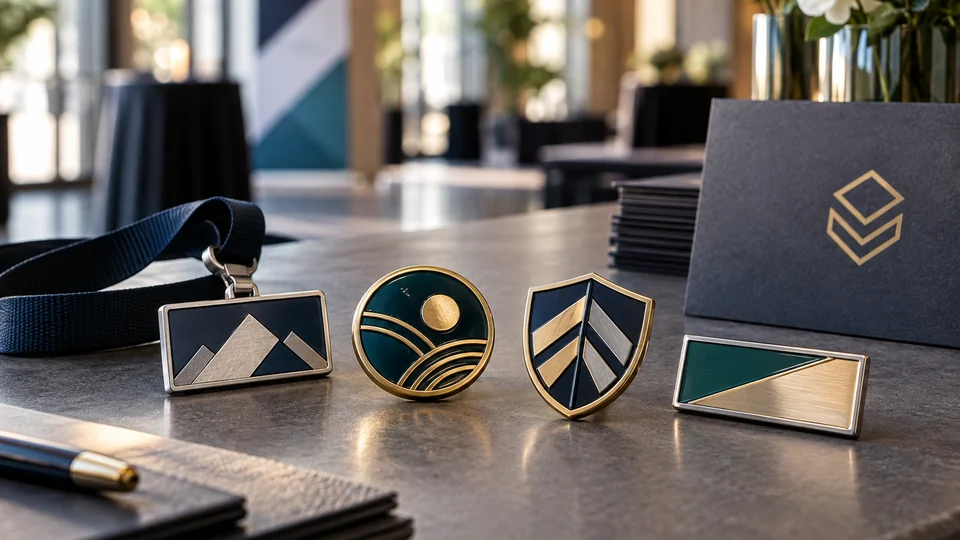
Corporate events give people a reason to meet, learn and represent a shared organization. A custom metal badge can make that experience more memorable—but only when it is designed for the people who will wear it and the job it needs to do. A speaker pin, employee recognition badge and attendee credential may all carry a logo, yet each calls for a different specification.
That distinction matters in 2026, when event teams are being asked to make merchandise feel more intentional. In the PPAI 2026 trends research, 60% of buyers said they would reduce quantity first when budgets tighten, while 11% said they would reduce customization. For an event planner, that is a useful prompt: order for the right people and protect the details that make the badge feel considered, rather than producing a large batch of generic giveaways.
Start with the event purpose—not the shape
Before choosing a shield, circle or custom outline, define what the badge should accomplish. Most corporate event programs fit one or more of these goals:
- Recognition: thank employees, speakers, volunteers, sponsors or long-service team members.
- Belonging: create a wearable marker for a company anniversary, membership group, product launch or annual summit.
- Brand experience: give customers and partners a tactile, well-made reminder of the event.
- Wayfinding or access: distinguish roles, tracks or access levels. If the badge controls entry, treat it as a credential and confirm the full security and check-in system; a decorative pin alone is not an access-control solution.
Settle the primary use first. Then compare a custom metal badge with a smaller custom metal lapel pin or a practical metal name tag. The best choice depends on wear time, clothing, visibility and whether names or roles change from one recipient to another.
Design a badge people will want to wear
Make the main idea readable at a glance
Badges are small, so a full event theme, detailed logo, date, location, sponsor list and slogan can compete for the same limited space. Choose one visual focal point—usually the brand mark, event symbol or award level—and remove details that do not help the wearer. Tiny text and narrow gaps can disappear during production or become difficult to read at normal viewing distance.
Use clear contrast between raised metal and recessed color. If the design uses several enamel colors, define them in a marked-up proof and approve the color references before sampling. For a stronger three-dimensional look, keep raised outlines broad enough to separate adjacent color areas. The custom metal badges guide explains how artwork, relief and enamel choices affect the finished appearance.
Choose shape and dimensions around the artwork
A custom-cut outline can echo a logo or event symbol, while a circle, shield or rectangle can create a familiar, balanced canvas. The outer shape should protect the important parts of the artwork and leave room for a secure attachment on the back. Before approving the size, review the design at actual scale—not only enlarged on a screen—and check whether its weight will feel comfortable on the intended garment.
For a deeper look at proportions, thickness and attachment clearance, see the custom metal badge size and thickness guide.
Select metal, finish and color for the program
The manufacturing process changes what a design can express. Stamped brass or iron can suit crisp, flatter artwork and defined metal borders. Zinc alloy can support more dimensional shapes and deeper relief. The right option depends on the artwork, desired feel, quantity and target budget—not on a universal “best” metal. Compare the trade-offs in zinc alloy vs. brass custom badges before locking the specification.
Next, choose a finish that reinforces the brand rather than distracting from it. Bright gold or silver can feel formal and polished; antique finishes add contrast to recessed details; black nickel can create a darker, contemporary outline. Enamel can bring brand colors into the design, but simpler artwork often benefits from fewer, larger color fields. Explore the gold, silver and antique plating guide and soft vs. hard enamel comparison when narrowing the options.
Match the backing to the clothing and wear time
An attractive front is only half of a wearable badge. A light lapel pin may work well with a butterfly clutch or rubber clutch. A locking clutch can add retention for a badge that will be worn throughout a busy event. A magnetic attachment can avoid pinholes on suitable garments, but it should be tested with the actual badge weight and fabric. Large or heavy pieces may need a different attachment or a smaller design.
Tell the manufacturer what the badge will attach to—suit lapels, uniforms, lanyards, bags or presentation cards—and whether recipients will wear it for a few hours or reuse it. Review the available metal pin backing types before sampling. If the product is a staff name badge rather than a commemorative pin, a magnetic or other name-tag mounting system may be more appropriate.
Plan quantities around attendee groups
Start with a simple count by recipient: attendees, speakers, staff, sponsors, VIP guests and award recipients. Add a reasonable reserve for late registrations, replacements and on-site changes. Keep role-specific variants separate in the count so the quote clearly shows the quantity for each design or variable-data version.
For a limited budget, consider whether one well-finished badge for a smaller group will serve the event better than a lower-spec item for everyone. The IRF 2026 Trends Report describes pressure on event-gifting budgets and a shift toward more curated, higher-value gifts. That does not mean every event needs a premium badge; it means the recipient, purpose and perceived value should guide the quantity and specification together.
Ask the manufacturer to confirm the minimum order for the chosen process, any price breaks at different quantities and how variable names or role designs affect tooling and unit cost. See the custom metal badge pricing guide for the factors that commonly change a quote.
Use packaging to finish the experience
Packaging may be a simple protective bag, a branded backing card or a presentation box for speakers and award recipients. A card can carry the event name, a short thank-you or a practical note about the badge. Confirm whether each piece must be individually packed, sorted by role, or shipped in bulk to an event venue. These choices affect packing labor, carton volume and the time needed for final kitting.
Ask for the available packaging materials and specifications rather than making broad environmental claims. If reduced plastic, recyclable materials or individual presentation are important requirements, include them in the initial brief and confirm what the supplier can document.
Work backward from the event date
Do not plan only for the factory production window. A complete schedule also needs artwork review, proof revisions, sample approval, bulk production, packing, international or domestic shipping and a buffer for delays. Share the in-hand date and delivery country when requesting a quote. Ask which milestone requires your approval and how a late artwork change would affect the schedule.
For a first order or a high-visibility event, approve a physical sample that reflects the intended metal, finish, color, backing and packaging. The sample is your chance to check real-world scale, weight, color contrast and attachment—not just whether the logo is centered. The metal badge manufacturing guide walks through the stages from artwork and tooling to finishing and inspection.
Corporate event badge quote checklist
Send a concise, complete brief to reduce follow-up and make supplier quotes easier to compare:
- Event name, purpose, event date, delivery country and in-hand deadline.
- Recipient groups and quantities by design, including any reserve stock.
- Logo or artwork files, color references and any required text or variable names.
- Target badge dimensions, shape, thickness and expected wearing time.
- Preferred metal, plating finish, enamel or print colors, if already decided.
- Backing type and the fabric, lanyard, bag or surface it will attach to.
- Packaging, sorting, backing-card or presentation-box requirements.
- Budget range, sample expectations and any testing or documentation requirements.
If some choices are still open, say so. A manufacturer can recommend options when the use case, quantity and budget range are clear. You can send the artwork and event details through the BadgeCraft quote form to discuss a suitable specification.
Frequently asked questions
What are custom metal badges used for at corporate events?
They can recognize speakers, employees, sponsors, members or event teams; reinforce a brand experience; and serve as a keepsake. If a badge is meant to control access, it needs to be part of a separately planned credential and check-in system.
How many custom event badges should I order?
Count each recipient group, add a modest reserve for late registrations and replacements, and ask the manufacturer to confirm the minimum order and price breaks for your specific design.
Which backing is best for an event badge?
Butterfly and rubber clutches are common for lightweight pins; a locking clutch can help with retention; and a magnet can avoid pinholes on suitable clothing. Badge weight, fabric and wear time should determine the final choice.
When should I request a quote?
Start when you know the event date and approximate quantity. Allow time for artwork review, sample approval, production, shipping and a contingency before the event.
Sources and further reading
Trend context in this guide comes from PPAI’s 2026 promotional products trends research and the IRF 2026 Trends Report. Event-specific recommendations are practical planning guidance; confirm manufacturing details, current minimums and lead times with your supplier for each project.