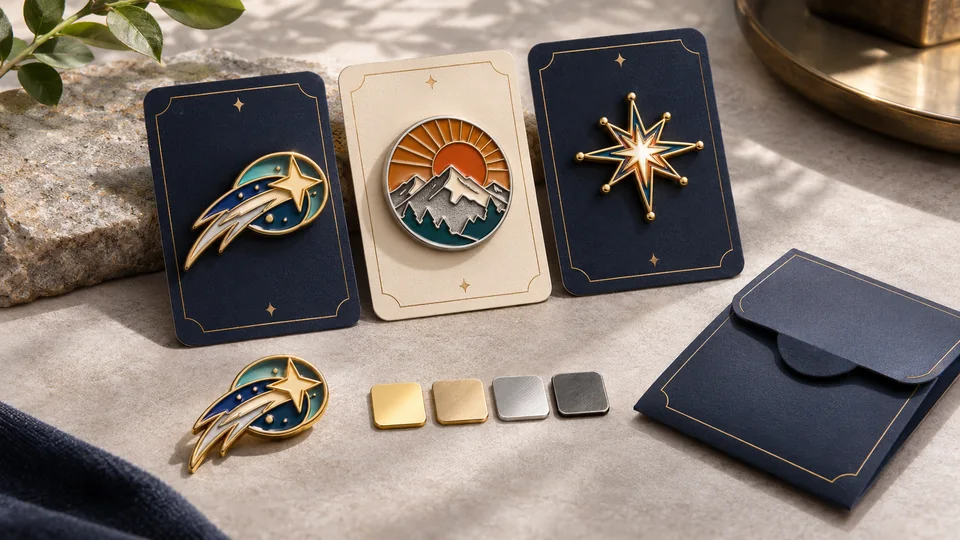
Short answer: to produce licensed custom metal pins, confirm the product rights and approval route before artwork enters manufacturing. Define the authorized marks, product type, territory, sales channels, term, quantities and required notices from the actual license program. Then submit the concept, approve the production artwork and specification, review a physical sample when required, and release bulk production only against the final authorized version. A pin factory can manufacture an approved design; it cannot grant permission to use someone else’s intellectual property.
Why licensed custom metal pins are getting attention
Licensed merchandise connects a familiar story or identity with a physical product. For a pin buyer, that can mean an approved character collection, a sports collaboration, a museum partnership, a destination series or a brand extension. Metal and enamel offer a compact format for color, relief, finish and edition variation, but the commercial opportunity depends on the rights, audience, product quality and distribution plan—not on the material alone.
The broader licensing market provides context. Licensing International’s 2026 Global Licensing Industry Study reports that licensed merchandise and services generated $389.8 billion in worldwide sales in 2025, up 5.45% from $369.6 billion in 2024. This covers many product categories and services; it is not a pin-market estimate. In the United States, PPAI’s study with Oxford Economics estimated a $174 billion branded merchandise market for 2025, including $50 billion in promotional products and $124 billion in licensed merchandise. PPAI explains that the two figures describe distinct parts of the wider market, not separate proof of metal-pin growth.
There is also a visible collector use case. During the Milano Cortina 2026 Winter Games, the Associated Press reported collectors pursuing limited city pins and trading at an official pin center. Its coverage described more than 1,000 people appearing at one city location on the first day and 600 at another the next day; it also reported that officially marked Olympic pin programs were produced under specific rights. This is a reported event example, not a forecast that every pin release will sell out. It does show why series design, availability, authenticity and permitted use matter when a pin is part of a licensed program.
The opportunity for a brand team is to make the product feel worth keeping while making the approval chain easy to follow. A pin that looks appealing but falls outside the license scope cannot be sold as planned. A correctly authorized pin that arrives after the launch date or fails to match its approved sample can also undermine the program. Treat creative development and rights management as linked workstreams from the start.
Confirm the rights and product scope before designing
Begin with the rights holder, licensee or authorized licensing representative. Ask which marks and artwork may appear, which product categories are covered, where the item may be sold or distributed, through which channels, and during what dates. The signed agreement and program instructions control these details. A license for apparel, for example, should not be assumed to cover enamel pins; a right to use an image in a campaign should not automatically be treated as a right to manufacture and sell that image on merchandise.
USPTO guidance explains that trademark rights are tied to goods and services and that owners can prevent others from using the same or a similar mark on related goods without permission. Copyright is a separate kind of protection for original creative work. The practical implication for a buyer is simple: a file found online, a fan-created drawing, a character reference or a partner’s logo is not production authorization by itself. Confirm the permissions for the exact design and intended commercial use before sending artwork to a factory.
Create a one-page project rights summary for the team and supplier. Include:
- Rights owner and licensee: the legal or program names used in the approval workflow, plus the person who can authorize production.
- Permitted intellectual property: approved logos, characters, wordmarks, color palettes, slogans, artwork files and any prohibited combinations.
- Product and region: metal lapel pins, enamel badges or other specifically covered items, along with authorized countries or territories.
- Sales and distribution channels: retail, event, membership, employee or promotional distribution as stated in the program.
- Term and launch window: approval, production, on-sale and end dates, including any restrictions on remaining stock or reorders.
- Required notices and approvals: copyright lines, trademark notices, licensee identifiers, packaging requirements, sample submissions and final sign-off steps.
Do not send the manufacturer confidential contract details that are not needed for production. Instead, the licensee can provide a rights summary, approved brand assets, written authorization or other permitted documentation that gives the factory enough information to confirm the order is ready to quote and manufacture. If a scope question is unclear, refer it back to the rights holder or qualified counsel rather than asking the production team to interpret the contract.
Choose a pin format that suits the artwork and the approval rules
After the rights and use are clear, translate the concept into a manufacturable metal pin specification. The construction affects appearance, detail, weight, price and the physical sample the licensor will review. It also affects how well a design remains recognizable at its final size.
- Soft enamel: raised metal borders separate colored areas, with enamel sitting below the lines. It can suit bold color blocks and clearly separated details.
- Hard enamel: color is polished closer to the metal plane for a smoother face. Confirm that artwork details, color divisions and finish expectations suit the selected process.
- Die-struck or no-color metal: relief and metal finish carry the design. This can work for a classic emblem or simplified mark, subject to the licensor’s approved style.
- Printed or mixed construction: printing or layered elements may preserve gradients or fine imagery, but the process and look should be approved on a production-representative sample.
These are manufacturing options, not licensing permissions. A rights holder may approve only certain colors, proportions, placement or visual treatments. Compare the site’s guides to metal pin materials and soft vs. hard enamel pins, then specify the chosen method in the art approval brief.
Specify size, thickness, front and reverse artwork, edge treatment, plating, attachment and package early. A small pin may not hold microtext or a complicated mark clearly; a broad or heavy pin may require more than one attachment point. Review the custom metal badge size and thickness guide, metal pin backing types and plating options guide to prepare a complete production specification. The rights holder should approve the actual production layout, not just a concept sketch.
Plan a collectible series without making inventory hard to manage
A pin series can create a reason for customers, members or fans to return for another design. The strongest structure is easy to understand: a shared visual system, a manageable number of variants and a clear role for each release. A collection might use one core emblem with alternate approved colorways, a set of locations, a sequence of story moments or a small group of characters. The right assortment depends on the rights, audience and sales plan.
Before a licensor approves the artwork, decide how many SKUs you actually need. Every extra version may create separate proofs, sample decisions, purchase quantities, packaging labels and inventory records. If the design changes by region, event date or retailer, name each version clearly in the art files and production order. Keep a master SKU list with the approved image, revision, color, quantity, packaging and destination for each item.
Use “limited edition” carefully. If the program says an item is limited, document what is limited: the production quantity, sale period, distribution location or another defined boundary. Make sure later reorders, seconds or promotional distributions do not contradict the statement. A numbered card or stated quantity can add collectibility, but only if the numbering and remaining inventory are controlled and approved. Scarcity language alone does not make a design desirable.
Also plan the physical experience. A pin may be sold on a backing card, in a set, inside a gift box or as part of a larger licensed product. The package protects the pin and communicates the approved marks, SKU and product information. The finished pin and card should look like one intentional retail product rather than an unrelated badge attached at the last minute.
Build a controlled artwork approval process
Licensed custom enamel pins typically pass through more than one creative handoff. The brand team may develop the concept, the licensee prepares a production file, the rights holder reviews it, and the manufacturer converts it into a proof. Make the current revision visible to everyone so that an earlier design cannot accidentally move into tooling.
- Collect approved assets: use the rights holder’s current logo, character art, typography, color standards and placement rules. Record file source and revision.
- Prepare a production concept: show proposed size, pin shape, color separations, relief, metal finish, reverse details and package approach. Flag any details the manufacturing process may need to simplify.
- Submit the concept to the authorized reviewer: include the product type and intended distribution context so reviewers assess the actual use rather than an isolated image.
- Convert approved art into a dimensioned proof: label the design revision, measurements, finish, color references, attachment and any approved legal notices.
- Record decisions and changes: keep reviewer comments, approval dates and revised files together. Route each change back through the program’s required approval path.
- Approve the physical sample when required: compare the sample with the final proof and evaluate size, color, plating, relief, edges, attachment and packaging under realistic conditions.
Do not treat a factory’s technical confirmation as licensor approval, or a licensor’s concept approval as production release. Those are different checks. In your project tracker, name the person responsible for each: rights clearance, artwork approval, manufacturing proof, physical sample and bulk release. Ask the licensing contact how long each review normally takes, but use a project-specific deadline instead of assuming a universal approval service level.
For visual consistency, use one shared reference for color and finish. A screen rendering can communicate the idea, but displays vary and simulated metallic effects can be misleading. For a new or high-profile design, review a physical sample. The metal badge quality checklist provides a practical inspection sequence for artwork, dimensions, plating, enamel, attachments and packaging.
Approve a sample and lock the production version
Before approving bulk production, make sure the sample represents the specification that will actually be manufactured. Check front and reverse artwork, orientation, size, thickness, relief, color placement, plating, surface polish, attachment position and the edge. If the badge will be worn, test the backing on a representative garment. If it is a retail collectible, inspect how it sits on the backing card and whether packaging protects the finish.
Ask the manufacturer to identify any deviations between the approved art and the physical sample. If a small feature has been widened, a line merged, a color changed or a reverse mark repositioned for production, document the decision and obtain any additional authorization the licensing program requires. Do not assume that a technically necessary change is automatically acceptable to the rights holder.
Once the sample and required approvals are complete, freeze the approved production file. Give it a unique revision code and connect it to the order, quantity by SKU, packaging proof and authorized release date. If a later change affects color, wording, package, dimensions or license markings, pause and confirm whether the change needs a new approval or sample. For a full overview of forming, plating, color filling and inspection stages, see the site’s metal badge manufacturing process guide.
During production, agree how the order will be checked and how variants will be separated. Identify which colorways or SKUs need a first-off inspection, how cartons will be labeled, what reference sample will be kept and who can authorize a correction. A well-maintained approval trail makes repeat orders easier and helps prevent an old, expired or unapproved design from being reused by mistake.
Handle authenticity marks and packaging through the license program
Rights holders may require a copyright notice, trademark line, licensee name, manufacturer identifier, product code, country-of-origin statement, backstamp or special package treatment. No single marking applies to every licensed pin. Ask which information is mandatory, what exact wording and symbol are approved, where it must appear and whether it belongs on the pin, backing card, outer package or invoice documentation.
Never add an “official,” “authorized,” numbered edition or authenticity mark just because it looks convincing. A mark can create a misleading impression if the program has not approved it. If the brand asks for a backstamp or traceability code, confirm the artwork, placement, SKU mapping and batch records before tooling. Do not substitute a factory logo for a licensor’s required mark or imply the factory is itself the rights holder.
Packaging often needs its own review. Check the card dimensions, pin placement, sharp-point protection, barcodes, required notices, retail labels and any local-language text. Confirm that each variant’s card matches the corresponding pin and SKU. If a collection uses multiple characters or colors, a final pack-out plan can prevent wrong designs from being placed in the wrong carton or retail set.
Budget quantity, approvals and the actual in-hand date
Price a licensed pin program as a complete project, not just a unit price. Manufacturing costs can vary with size, thickness, tooling, metal construction, color count, plating, attachment, packaging, quantity and freight. Licensing fees, royalties, approval charges or retailer terms may sit outside the factory quote, so identify who owns each cost line. For manufacturing variables, use the site’s custom enamel pin cost guide and custom metal badge pricing guide as starting points.
Quote comparable options using the same approved specification and quantity tiers. If the art or finish changes between supplier quotes, the prices do not represent the same item. For a collection, separate tooling and production quantities by SKU and ask whether a shared tool or common construction can be used without changing the approved product design. Confirm whether tooling is one-time or applies again if a design or size changes; do not assume the terms are identical across suppliers.
Schedule backward from the date product must be physically available at the destination. Include time for rights confirmation, art review, proof revisions, sample production, licensor review, bulk manufacturing, packaging, freight, customs where relevant and a contingency for corrections. The manufacturer can estimate production after receiving the actual specification, but the license review schedule usually belongs to the brand or licensing program. Put both workstreams on one calendar so a delayed approval does not become an avoidable rush order.
Set order quantity from a realistic sales or distribution plan. For limited runs, coordinate the cap with the approved license and inventory rules. For ongoing retail items, forecast initial demand and a reorder trigger rather than ordering a large quantity only to reach a lower unit price. Reorders still need the correct current artwork revision and permission to produce during the license term.
Common mistakes to prevent in licensed pin production
- Sending artwork before confirming rights: establish that the intended pin and commercial use fall within the authorization first.
- Assuming a public logo file is production-ready: use approved brand assets and preserve required proportions, colors and clear space.
- Combining an unapproved character with a partner logo: confirm co-branding rules and hierarchy with the authorized reviewer.
- Skipping physical sample approval: a digital mockup cannot fully show actual plating, enamel, edge, weight or packaging fit.
- Using vague revision names: replace “final-final” with a controlled project code, date and revision number.
- Changing the design after approval without reopening review: even a small change to color, scale, legal copy or package may need additional approval.
- Inventing authenticity language: use only marks, backstamps and edition claims approved for the licensed product.
- Ignoring sales channel or territory limits: an approved design may still have restrictions on where, when or how it can be sold.
- Ordering all variants under one vague quantity: show quantities by SKU, package and destination to keep production and inventory traceable.
- Planning from a generic lead time: include actual licensor review, sample, freight and delivery dates in the schedule.
Copyable licensed custom pin project checklist
Use this brief to align the licensee, rights holder, manufacturer, distributor and retail team before requesting a production quote:
- Rights: rights owner, licensee, authorization reference, product category, territories, channels and license dates.
- Approved assets: source files, brand guide, allowed logos or characters, required notices and prohibited combinations.
- Review path: concept reviewer, production-art reviewer, sample reviewer, package reviewer and final bulk-release authority.
- Product: target size, thickness, relief, construction, finish, color reference, attachment and backstamp requirements.
- Series and SKUs: design names, variant list, quantities per version, release plan, edition wording and reorder policy.
- Packaging: card or box artwork, barcode and legal copy, pin placement, protection, set configuration and carton labels.
- Quality: physical sample requirement, inspection reference, acceptable deviations and batch identification plan.
- Commercials: tooling, sample, unit price tiers, packaging, freight, royalty or licensing cost owner and quote validity.
- Schedule: art deadlines, approval turnaround, sample date, bulk release, production, shipping and in-hand date.
If your artwork and rights are ready, compare custom metal pins and custom lapel pins, then send the product scope, quantities, finish and packaging requirements through the quote request page. Include the approved art version and required review stages so the manufacturer can quote a realistic production path.
Frequently asked questions
Can a manufacturer make metal pins using a licensed logo or character?
A manufacturer can produce a design when the buyer or licensee has the necessary authorization for the product, territory, channels and dates involved, and required approvals are complete. A factory does not grant trademark or copyright rights. Provide approved artwork and follow the actual license program’s rules.
What approvals are usually needed for licensed enamel pins?
Requirements vary. A program may require concept, artwork, product specification, digital proof, physical sample, packaging and final bulk approvals. Confirm the exact sequence and authorized reviewers with the rights holder before setting a launch date.
Does every licensed pin need a backstamp or authenticity mark?
No single marking rule applies to every licensed product. The rights holder may specify a notice, code, licensee or manufacturer identification, backstamp or other detail. Use only the approved wording and placement confirmed for that program.
How should I plan a collectible pin series?
Give each pin a clear place in the collection, limit variants to those the audience and sales plan justify, and map every design to a SKU, quantity and approved package. Document any “limited edition” claim and ensure the actual production and distribution follow that limit.
How long does licensed custom pin production take?
It depends on artwork readiness, rights-holder review, sample rounds, construction, quantity, packaging and freight. Work backward from the in-hand date and schedule each approval separately. Request an order-specific timeline from both the manufacturer and licensing contact.
Can I use an image found online as artwork for custom pins?
Online availability does not establish permission to reproduce an image on a commercial product. Confirm rights for logos, characters, photographs and artwork, then provide the manufacturer with the approved production files and usage restrictions.
Are licensed pins the same as promotional event pins?
They can overlap, but the terms describe different things. “Event pin” describes the occasion or use; “licensed pin” describes the authorized intellectual property on the product. A pin can be both, so plan event logistics as well as the license approvals.
Sources and further reading
- Licensing International, “2026 Global Study Shows Licensing Industry’s Continued Growth, Reaching $389.8 Billion in Sales” — 2026 study reporting 2025 global sales of licensed merchandise and services; the figures cover broad categories, not pins alone.
- PPAI, “Inside the $174 Billion US Branded Merchandise Market” — Oxford Economics study summary explaining the U.S. branded merchandise spending estimate and its licensed merchandise and promotional product components.
- Associated Press, “Olympic pin mania has collectors running between landmarks and swarming a trading center” (February 11, 2026) — reporting on collector behavior, city pin releases, trading and the rights structure around official Olympic pins at Milano Cortina.
- U.S. Patent and Trademark Office, “Trademark scope of protection” — overview of how U.S. trademark protection relates to identified goods and services.
- U.S. Patent and Trademark Office, “Trademark, patent, or copyright” — overview distinguishing common intellectual property categories and the rights they protect.
Editorial note: Licensing market figures cited here cover broad merchandise and service categories, and the Olympic pin example is a specific event case. Neither source establishes the size or growth rate of the custom metal pin market. Licensing terms and intellectual property rules vary by contract and jurisdiction; buyers should follow their rights-holder’s instructions and obtain qualified advice for legal questions.